
A year can finish with money left over even if one of its month-end balances is lower. Dashboard therefore shows a cash path across the selected period, as well as the balance at the end.
The calculation starts from account opening balances and follows income, expenses and transfers over time. For an occurrence with a recorded actual, projections use the actual amount and date while keeping its planned values available for comparison; an occurrence without an actual follows its saved schedule. The result describes those records, not a guaranteed future bank balance.
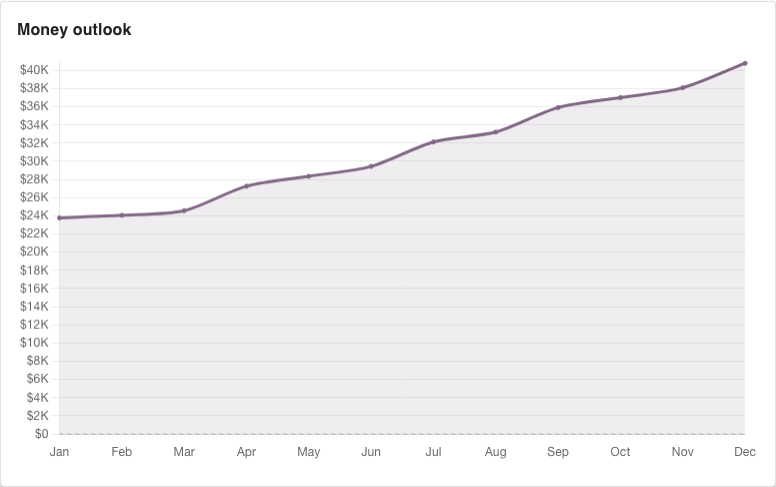
What feeds each month
For each displayed month, Dashboard summarizes:
- income;
- ordinary expenses;
- net change for the month; and
- projected cash at month end.
Transfers are excluded from ordinary expense totals. When both accounts are included in the selected view, moving cash between them changes each account's balance but leaves combined cash unchanged.
Ending cash and lowest cash answer different questions
Projected ending cash is the projected cash balance for the final displayed month.
Lowest projected cash balance is the smallest of the displayed month-end balances. A lower amount that occurs and recovers between month ends is not represented by this monthly measure.
For example:
| Month | Income | Ordinary expenses | Net change | Month-end cash |
|---|---|---|---|---|
| October | $5,000 | $4,400 | +$600 | $3,100 |
| November | $5,000 | $5,300 | −$300 | $2,800 |
| December | $5,200 | $4,600 | +$600 | $3,400 |
In this fictional example, the balance before October is $2,500. October adds $600, November reduces the balance by $300, and December adds $600.
The plan ends at $3,400, but its lowest point is $2,800 in November.
That difference is exactly why both values are shown.
Period labels follow the selected year type
For a calendar-year view, the selected period ends on 31 December. For an Australian financial-year view, it ends on 30 June of the year shown. See Understand your Budgetezy dashboard for how to switch the period.
How estimated net worth connects
For a calendar-year view, estimated net worth is:
estimated net worth = projected ending cash + recorded asset balances - recorded liability balances
For the selected 31 December, Budgetezy uses the latest asset and liability balance adjustment recorded by that date, or the opening balance if there is no adjustment by then. An item is included once its opening-balance date falls in or before the selected year.
Estimated net worth is not calculated for the Australian financial-year Dashboard. Asset and liability balances are recorded at a calendar-year end (31 December), while the selected financial year ends six months earlier on 30 June.
What a projection can and cannot know
The projection can only use the records represented in Budgetezy. If a future payment is missing from the plan, it will not appear. If a saved amount or date changes, the projection can change with it. Treat the result as a view of the current saved plan and recorded actuals, not a guaranteed future bank balance.
See Understand your Budgetezy dashboard for how these values sit alongside the other Dashboard cards.